Basically, the article was about how the columnist wrote a section in the newspaper regarding the amount of debt that college graduates have to face as soon as they get their diplomas. It also states the importance of saving and how a little money you save monthly for example around 250 dollars, can add up to thousands that you can retire to by the time you reach 60. I think that the advice he gives is very smart and has inspired me to start saving as soon as I can because it will definitely pay off by the time I am old and wrinkly.
To save, I can cut down on shopping for uneccessary clothing, shoes etc. I also can stop eating out as much with my friends in fast food places and I think that adds up a lot. It's really important to save in life because a lot of time people pay their bills and everything that have to pay and the little money that they have left over and spend it on petty things because they feel like it is more important. But the reality is that if in the future, you want to retire and settle down you should save money since a young age so you can have something to rely on when you get older.
One tip that the author mentions that I plan to apply to my life is saving around 100 dollars a month for every month. Eventually that will add up to enough money so I can have some extra money when I get older to help me settle down and buy a house to grow old in !
Tuesday, June 5, 2007

Wednesday, May 23, 2007
Taxes - How does the governement get money?
I read an article named Bush has no right to spend taxes pushing religious values and totally agree with it. It talks about how President bush feels that he has the right to spend the money that comes out of our pocket to spread his influence and his beliefs for public schools, agencies and reason. This is an example of how the federal government spends tax money that they collect from us. Things like military, parks, jails are all part of the federal government "bill" so to speak.

As read on the article How Washington Will Spend Your Taxes In 2005, the federal government spends an average of $22,039 on each household. That amount of money is divided into subgroups of the following: Social Security/Medicare, Defense, Low income programs, interest on the federal debt, federal employee retirement benefits, education, health research, veteran benefits, highways/other transit, justice administration, unemployment benefits, international affairs, natural resource environments, and lastly agriculture. So as you can see each household is spent a very low income and it's spent on a whole lot pf things that we mostly have nothing to do with and the government takes that money that we get no benefit from, out of our paychecks.
I think that a lot of people do not realize how much the government takes advantage and steals our hard earned money off of taxes to please their needs that don't concern us in any way. I strongly disagree with that and I think that needs to change because nothing is being done about it and we are the ones that are paying the price at the end of the day!
As read on the article How Washington Will Spend Your Taxes In 2005, the federal government spends an average of $22,039 on each household. That amount of money is divided into subgroups of the following: Social Security/Medicare, Defense, Low income programs, interest on the federal debt, federal employee retirement benefits, education, health research, veteran benefits, highways/other transit, justice administration, unemployment benefits, international affairs, natural resource environments, and lastly agriculture. So as you can see each household is spent a very low income and it's spent on a whole lot pf things that we mostly have nothing to do with and the government takes that money that we get no benefit from, out of our paychecks.
I think that a lot of people do not realize how much the government takes advantage and steals our hard earned money off of taxes to please their needs that don't concern us in any way. I strongly disagree with that and I think that needs to change because nothing is being done about it and we are the ones that are paying the price at the end of the day!
Tuesday, May 22, 2007
Savings and Debt
After reading the "Couple learn the high price of easy credit debt", I am not surprised at all with how much money they owe and how deep they are in debt. I think that this nation is slowly but surely becoming poorer and poorer because the high amount of people that go crazy with credit cards not realizing how much of a burden it is going to be on them later on when they have to pay it all back. People get into debt easily simply because the price of life has definitely gone up in the last few decades and now a days to live comfortably you need to be able to make a comfortable salary which is going to provide for your living costs, your family needs and your food as well as other necessary expenses. Finance charges can be dangerous because the high amount of interest and the high amount of money that can accumulate when time passes by and you don't pay your money can really hurt you in the end and you end up paying them more  than the actual money you spend to begin with due to finance charges.
Americans don't save money anymore because the reality of it is that a good amount of Americans are living paycheck to paycheck and with their rent, mortgage, car payments, family expenses and everything else, they have nothing left over to save. The average family makes from 66,000 to 70,000 dollars a year which is not that much when you pay all your necessities so it's really hard to save and as time passes it will get even harder.
An article I found called Low U.S. savings rate could harm nation's competitive Strength talks about the importance of our country saving money to fund more necessary things such as education, research and other things that are essential and beneficial to our nation. With a low saving rate, interest rates are forced to go up and potentially can hurt the nation's people economically. The article also states that the U.S. is ranked among the lowest saving nations out of all of the industrialized nations.
than the actual money you spend to begin with due to finance charges.Americans don't save money anymore because the reality of it is that a good amount of Americans are living paycheck to paycheck and with their rent, mortgage, car payments, family expenses and everything else, they have nothing left over to save. The average family makes from 66,000 to 70,000 dollars a year which is not that much when you pay all your necessities so it's really hard to save and as time passes it will get even harder.
An article I found called Low U.S. savings rate could harm nation's competitive Strength talks about the importance of our country saving money to fund more necessary things such as education, research and other things that are essential and beneficial to our nation. With a low saving rate, interest rates are forced to go up and potentially can hurt the nation's people economically. The article also states that the U.S. is ranked among the lowest saving nations out of all of the industrialized nations.
Thursday, May 17, 2007
Critique of GDP Podcast
I will be critiquing Sharonna & Nadia's GDP Podcast.
I really enjoyed watching this podcast and I think they did a really good job. The content of the podcast is really thorough and they really go into depth regarding how the GDP is calculated and the ranks of the of money that the U.S. gets from GDP compared to other countries. I liked how they made the podcast into an information session that you would see on a show on television which made it a little more interesting and fun to watch.
Although they provided a lot of good information, I feel like they jumped from topic to topic way too quickly which made it hard to comprehend what they had just said since they just ran through every sentence. I also think that they could of spoke a little bit slower because at times, I couldn't really focus on what they were saying because of how fast they were talking and jumping from topic to topic at the same time.
I really liked the pictures that were used like the cartoon where there was a flag and the man was waving to it and his hat said made in China and so did the flag. They had a lot of informative political cartoons and made their point really clear especially with the fruits image when they were talking about imports and exports. I did think that the podcast was educational because they covered every single detail and I learned what per capita income, trade deficit and GDP is in depth and I know where the U.S. stands in the rankings.
I really enjoyed watching this podcast and I think they did a really good job. The content of the podcast is really thorough and they really go into depth regarding how the GDP is calculated and the ranks of the of money that the U.S. gets from GDP compared to other countries. I liked how they made the podcast into an information session that you would see on a show on television which made it a little more interesting and fun to watch.
Although they provided a lot of good information, I feel like they jumped from topic to topic way too quickly which made it hard to comprehend what they had just said since they just ran through every sentence. I also think that they could of spoke a little bit slower because at times, I couldn't really focus on what they were saying because of how fast they were talking and jumping from topic to topic at the same time.
I really liked the pictures that were used like the cartoon where there was a flag and the man was waving to it and his hat said made in China and so did the flag. They had a lot of informative political cartoons and made their point really clear especially with the fruits image when they were talking about imports and exports. I did think that the podcast was educational because they covered every single detail and I learned what per capita income, trade deficit and GDP is in depth and I know where the U.S. stands in the rankings.
U.S. Trade Deficit: getting better?

This artilcle mainly concentrates on the amount of imports and exports that America is involved in. It also explains the growth that other countries such as Europe and China and Japan and others compared to the slow rate that American has faced in the last century. But that recently has changed due to the high demand of exports which causes the need for more emplyment which ultimately contributes to our nation's economic growth. A trade deficit is when a nation is importing more than exporting goods which doesn't help you in the long run but instead just decreases the nation's economy. The U.S. trade deficit is likely to do down in the future because as said in the article the value of the dollar keeps decreasing while those of other countries are increasing at a fast pace like the Euro which is now worth $1.40 and a british ppound is up to a value of 2 dollars. The U.S. is selling things like General motors like engines as well as food businesses like KFC as mentioned in the article. A weak dollar can actually help the countries economic growth because it gives the American good more competition for other countries to purchase.
Taxes - How does the governement get money?
When it comes to taxes, the government is the most that benefits from them the most. The different types of taxes that Americans pay are Federal taxes, Real Estate and state taxes as well as all the taxes you pay when you purchase any item except clothing which is now tax free in the state of New York only if the item is under 100 dollars. The federal government gets money by the taxes that are taken away from each employed person and is given to the government to fund for things such as the war and other expenses that the country has. The state also gets money from deductions from the nations employment and is funded for necesities in that particular state. Local city governments get their money by smaller businesses and money gained from clothing, food, electronics etc.
Overall, the country gets money basically from it's people by deducting a certain portion of the nation's paychecks depending on their salary and is used for the nations neccessities most of the time.
Student Loans - BEWARE !

After reading the Top Chefs Dreams article in the New York times, I think that those students took out so many loans because they have aspirations to follow in the footsteps of successful, professionals chefs such as the ones that are seen on T.V. But even though they invest so much money in loans, most of the time they don't even make it big time and cant get a job after graduating because they are in so much debt that they have to live paycheck to paycheck. I think that student loans are okay for some people that need a little extra help to pay their tuition, but I definitely think it should be used with moderation. Applying for loans of 40,000 dollars or more a year is just not worth it because by the time you graduate you will be in so much debt that you wont be able to find a job and pursue a career. Yes, I do plan on taking out a student loan to pay for the amount of tuition that financial aid didn't give me. The loan will be around 6,000 dollars which I think is a reasonable price and wont be too much of a burden to pay back when I graduate.
Monday, March 19, 2007
Critique of Federal Reserve Podcast
I will be reviewing Sharon and Monica's Podcast !

- After reviewing their podcast I found it to be overall very informative and well put together. It covers every part of the lesson thoroughly and I liked how they used the teacher and student example. They were able to explain in depth every aspect of the fed like its history, its purpose, its effectiveness as well as how it all started. If that were my frist time leraning about "the fed" i would definitely be well informed with that in depth lesson and well organized podcast.
- The recording was a bit tremulous at first when Monica first introduced herself and was answering what the federal resserve system was. Also, her voice was a bit low at times but she raised it towards the end. Besides that, I was able to fully comprehend everything clearly.
- The images for their podcast were overall very good. But I think that at some points they used the same picture too many times like for example the uesd the "Q&A" picture too much, they could of used another picture when Sharon asked Monica the questions. But overall her pictures made sense with what she said and showed at the appropriate time.
- The podcast, I thought was very creative, especially with the whole Mrs. Fields thing which went with the picture of the actual Mrs. Fields cookies. I actually liked the whole teacher student idea because Sharon asked typical questions to Monica that I would also ask if I was the student. It was interesting and kept me awake instead of putting me to sleep. It was also humurous towards the end which made it that much better when Monica was going to ask Sharon how much money she made after explaining how the fed affects the nations economy.
- I did learn alot from the Podcast as I said before, they were able to explain every aspect of the fed clearly and I hardly have any questions bec ause they covered everything in depth.
Compound Interest and the rule of 72
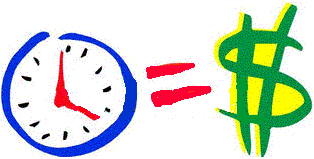
The dictionary definition of Compound interest is interest paid on both the principal and on accrued interest. Compound interest in general is the amount of interest that is earned by the amount of money that you gain. But you actually never get to touch that money. The more time invested, the more money in interest you will have. As my picture demonstrates, time equals money anywhere and everywhere. In the picture of Einstein pointing to the board, it says how compound interest is the ninth wonder of the world and he makes a point because with the 72 formula which basically calculates the amount of years that it will take for your money to double which is great. Albert Einstein is considered the father of compound interest because he created it. I think that he created this for wealthy people to benefit because the more money you have to begin with, the more the interest rate will go up and ultimately will make you richer in the end making wealthy people very powerful !
Monday, March 5, 2007
INSIDER TRADING SCANDAL !

On Thursday, 13 people were charged with crimes such as securities fraud, wire fraud, bribery among others in what some people are calling the most scandalous insider trading rings in years. It started with a ABS security accused of selling exclusive information on things such as analyst upgrades and another attorney accused of giving out classified information on mergers and acquisitions. Two brokers from Assent LLC found out and blackmailed the people involved. Out of the 13 people accused, four pleaded guilty. The SEC found out that the people involved in such schemes as these use disposable cell phones, secret codes and cash kickbacks to conceal their cunning conduct which results in them making profits as large as 15 million dollars over a 5 year time period.
Wednesday, February 28, 2007
Dow down 416 pts! - Why?
This Tuesday the Dow Jones Company experienced a downfall of stocks that left everyone in shock. The Dow Jones is a group of major stock companies that have all came together and since the Chinese stock market experienced a decline of about 9%, it caused other companies as well as the overall Dow Jones to experience an unexpected decline. Even though the decline was rather sudden, we knew that some decline was inevitable knowing that we hadn't had one since September 11. So the decline was bound to happen sooner or later. Tuesday's decline was pretty big news but in now way compares to the great amount of decline and economic hardship that was a cause of the Great Depression and all the stock markets that crashed. The Great Depression is the biggest decline in stocks and I think is hard to beat because even with the downfalls that companies face now a days, they don't compare to the amount of people that the Great Depression left unemployed and living on the streets.
With the Dow Jones decline and the stock market prices down I will definitely consider buying more stocks in order to expand my horizons. Even though I'm doing pretty well with the one stock that I have which is Christian Dior, I'll look into what I'm interested in and if it's worth investing in!
With the Dow Jones decline and the stock market prices down I will definitely consider buying more stocks in order to expand my horizons. Even though I'm doing pretty well with the one stock that I have which is Christian Dior, I'll look into what I'm interested in and if it's worth investing in!
Tuesday, February 27, 2007
Opportunity Costs
When economist talk about opportunity costs they mean that whatever they do such as build a corporation in a certain piece of land, they miss out on any other opportunities that they have for example building or constructing any other thing in that same land that can serve as a benefit towards them in the future. In economics opportunity costs are decisions that you make for what you most desire and the things that you are giving up for that one thing that you chose to do. An example of this is if you have a boyfriend/girlfriend. The time, money and effort you spend with him/her, you can be doing other things such as saving money for the future and hanging out with your friends having a good time. Some examples from my life can be that instead of a job I will start College Now. Instead of earning some money to save for college and other expenses, I will be getting a college education. Also, I am in the A.P. biology course first and second course. Instead of coming in third period and leaving fifth, I choose to come in first because I take that specific course and I feel that it will be better for me. =]
Friday, February 16, 2007
Types of Economic Systems
1) Traditional Economies - It's an economic system that have a strong social network as well as tools and methods. It's often connected to subsistence farming which means that you grow enough income to be stable rather than a large amount. In other countries, it's mostly replaces by command and mixed economy.
2) Centrally Planned (Command) Economy - This is an economic system where the state or government controls all of the factors and makes all the major decisions about their use and the amount of gross income they earn. The planneres decide what should be produced and command certain enterprises to produce those goods.
3) Market Economy - another economic system where the production and distribution of goods is controlled by free markets guided by a free price system rather than a planned economy where things are run by the state and/or government. In market economies different businessess decide what they want to buy produce. It has no central coordinator guiding the operations and usually goes hand in hand with self interest.
4) Mixed Economy - a mixed economy is an economic system that contains both private owned as well as state owned companies and also mixes elements like capitalism and socialism. Countries like United States, Canada, Cuba and others take part in mixed economies.
-What is the difference between communism and socialism?
Answer: The difference between communism and socialism is that in communism, the country controls all aspects of how the governed live and they have to live under the dictator's rules and regulations such as in Cuba. In socialism, a certain part of the government has control only on their economy and are responsible for the inports and exports. So communism is taking over all aspects and socialism is only economically taking over.
2) Centrally Planned (Command) Economy - This is an economic system where the state or government controls all of the factors and makes all the major decisions about their use and the amount of gross income they earn. The planneres decide what should be produced and command certain enterprises to produce those goods.
3) Market Economy - another economic system where the production and distribution of goods is controlled by free markets guided by a free price system rather than a planned economy where things are run by the state and/or government. In market economies different businessess decide what they want to buy produce. It has no central coordinator guiding the operations and usually goes hand in hand with self interest.
4) Mixed Economy - a mixed economy is an economic system that contains both private owned as well as state owned companies and also mixes elements like capitalism and socialism. Countries like United States, Canada, Cuba and others take part in mixed economies.
-What is the difference between communism and socialism?
Answer: The difference between communism and socialism is that in communism, the country controls all aspects of how the governed live and they have to live under the dictator's rules and regulations such as in Cuba. In socialism, a certain part of the government has control only on their economy and are responsible for the inports and exports. So communism is taking over all aspects and socialism is only economically taking over.
Tuesday, February 13, 2007
Plans
With the 50,000 that are going to be given to me, I am going to invest in the company Time Warner Company because it's only about 21 dollars per share and it can be a easy start for me.
Friday, February 2, 2007
Subscribe to:
Posts (Atom)